
I Got $75 For This Dashboard But Not A Job
Takeaways from a controversial data science interview practice: The take-home assignment.

Currently job searching? Give yourself an edge by developing a personal project using my free 5-page project ideation guide.
Shortly before I entered graduate school, I conducted my own version of “Dirty Jobs” as I looked for remote “gig” work. Already having a day job and a part-time job, I was looking for that elusive mixture of low-effort high return. So, I applied to a posting from a transcription company and after what I’m sure was a cursory glance at my resume, was immediately given a practice assignment to be completed on my own time.
Unpaid.
The recruiter assured me that I would only need to do 2 hours of transcription before they could consider me “accepted” and start paying me for work. Unfortunately, what they neglected to inform me (and every other applicant) was that 2 hours of transcription work != 2 hours of work.
With the amount of pausing, pressing my earbud deeper into my ear drum and “shh-ing” my surroundings, the time came out to roughly 2–3 hours per file. In an effort to game the system, I searched for the mp4 file I was given, found it on YouTube and copied/pasted the auto-generated transcription.
Needless to say, I was not hired.
This plus a few other instances of “play before pay” sourced my attitude toward any “required assignment” as part of the job interview process.
In data science (and tech more broadly) this is known as the take home assignment or, less formally, “the take home.”
On the surface, the premise of the take home benefits the interviewee/candidate, especially those averse to the dreaded whiteboard interview coding exercises. However, more often, a take home benefits your potential employer because:
- They determine (and have time to tweak) the assignment’s parameters and, consequently, expect higher quality work than on-the-spot coding
- Senior engineers and developers don’t have to be pulled off tasks to administer abstract coding tests; instead, your result will be passed around on an email/Teams thread for even greater scrutiny
- Take homes make a hiring decision easier since work is recorded instead of observed
And, I’m sure you’ve heard this horror story:
In worst-case scenarios, orgs get a few hours of free labor out of someone–work that may even make it into production.
So should you withdraw your candidacy with an org whose hiring process requires a take home component?
Not necessarily.
As the title suggests, I participated in a take home process that rewarded my time with compensation (more on that below); in my opinion, ethical, candidate-respecting processes certainly exist.
But to identify and thrive within one you should work to establish and stick to ground rules, as I did with the only data science take home I’ve completed (to date).
Since I bear no ill will toward the company I interviewed with prior to landing my current position, I don’t have an issue 1) naming them and 2) describing the arrangement.
Later in my initial job search I received a follow-up to an application I submitted to the world’s most famous conference organizers: TED (Technology, Education, Design).
Reflecting upon the position years later, it was, perhaps, a bit much for a fresh graduate to take on as a first gig. Though the job title was “data analyst”, the scope of the role was larger and assumed deeper knowledge in Google Analytics, SEO and web tracking.
But I had a decent phone interview with the recruiter and I was invited to complete an “at-home assignment.” The email made it very clear that:
- The assignment would and should take many hours to sufficiently complete
- I would be paid $75 for that time
To demonstrate the commitment to compensation for effort, the email encouraged me to send along an invoice with bank details to accompany the final submission.
Initially, I expected an assignment that would mimic school homework. If you’re a data science student you might recognize these purposefully vague parameters:
- Find 1–2 data sources
- Train x model on them
- Generate 2–3 visualizations along with a summary of results
Instead, I was to analyze attached CSVs to answer both data analysis-oriented and domain-based questions, like “Which campaign resulted in more traffic during (timeframe)?”
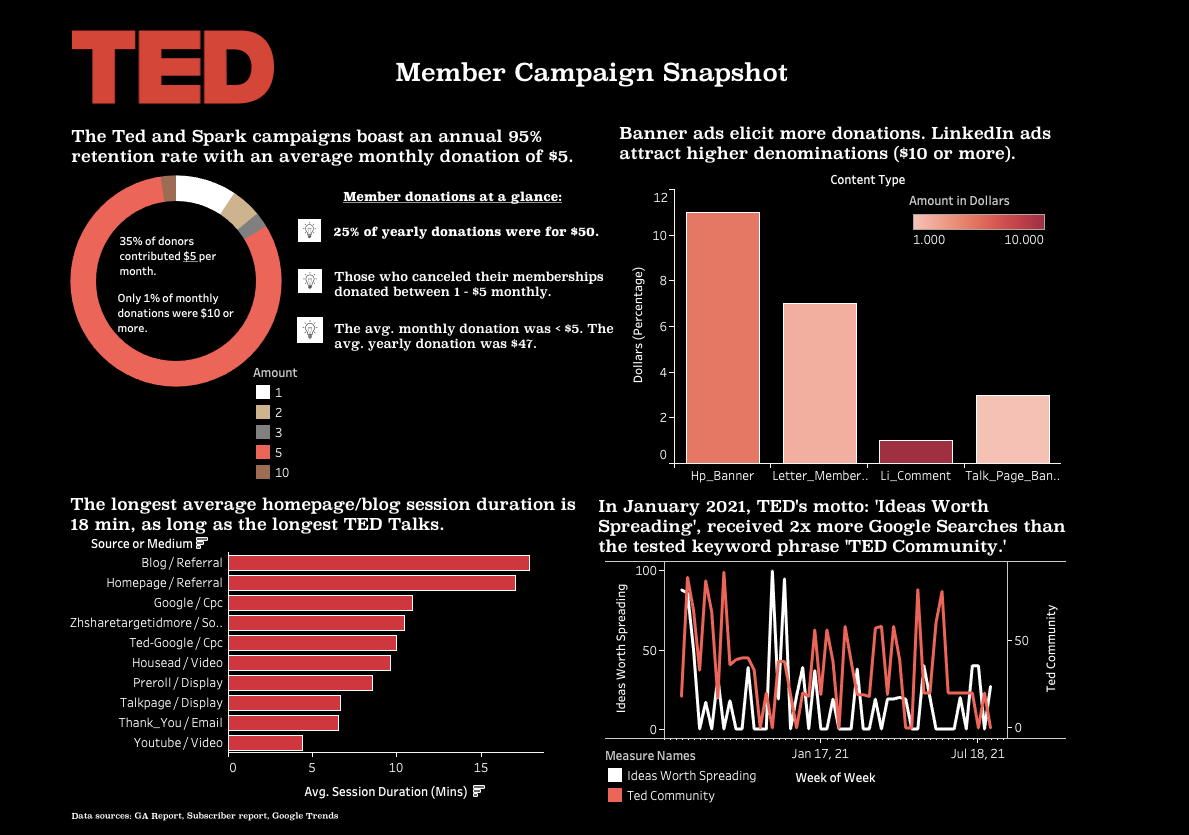
While specific, the assignment also encouraged the sourcing and inclusion of secondary data sources to support any analysis conducted, which is how I ended up incorporating Google Trends data into my final dashboard (included at the end of the page).
Even though I made $75 to do this work, I can’t emphasize enough that I WORKED for that money.
The granularity of the provided data and specificity of the questions meant that I most likely sunk 10–15 hours into the assignment to generate a half-decent dash.
Since this was my first time on the data science job market, I didn’t value my time as much as I should have.
Although it’s not about the money at this stage (clearly: 75/15 = $5/hour), I lost 1–2 days of time I could have been applying to and preparing for other jobs and interviews, since I had not yet received a job offer.
Assuming you find yourself in a similar scenario in which a potential employer offers to pay you for your services either:
- Ensure the pay and/or potential of landing the job is high enough to make it worth time invested in something you might not get any ROI on (i.e. not landing the job)
- Be comfortable with limiting time invested to ensure you’re still able to sufficiently explore other opportunities
If you find yourself in an unpaid situation be sure to take the following steps to conserve your mental energy and preserve personal security:
- Get clarity on exactly how long a hiring manager expects the exercise to take; the hiring processes I’ve been part of clarify that a relatively easy data engineering exercise shouldn’t take more than 2–3 hours of a candidate’s time
- Establish a scope for the work; an easy ETL pipeline in 2 hours is a reasonable ask; setting up a complex AirFlow DAG with 10 upstream sources is not
- Vet any paperwork you receive and be wary of signing any non-disclosure agreements; if you’re asked to work with production data this is usually a very bad sign
- Once submitted, get a hiring manager’s best estimate regarding review time and a decision timeline
To the last point, if you’re expected to produce work and send it out into the ether, hiring managers should expect to provide a reasonable estimate for an evaluation timeline.
In select situations, like if you have a competing offer, it is possible to ask for an accelerated decision timeline (respectfully, of course).
The worst part about the particular process I participated in was the review timeline. Since I was interviewing in the summer, several of the individuals in the hiring pipeline, including the financial department tasked with paying my “consultant” fee, were on weeks-long vacations.
In my case the radio silence turned out in my favor because I had just progressed in processes with the two organizations that ultimately offered me jobs.
If you find yourself idle after submitting work that is supposed to be evaluated in a mutually-agreed upon timeframe, you are certainly allowed to follow up on your submission.
Because take-home exams simulate job tasks, they really are one of the best ways to gauge a candidate’s ability not just to write code or complete a broader data project, but also to effectively function within a given domain and organization.
Especially as a new graduate, one of your greatest selling points is the ability to eventually contribute to the organization.
So, ideally, in the near future, the only whiteboard sessions you’re part of are sprint planning.
The Final Product
I need your help. Take a minute to answer a 3-question survey to tell me how I can help you outside this blog. All responses receive a free gift.